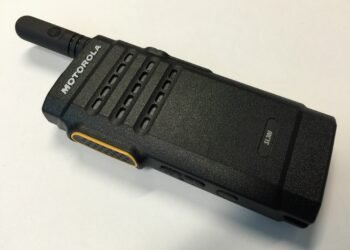




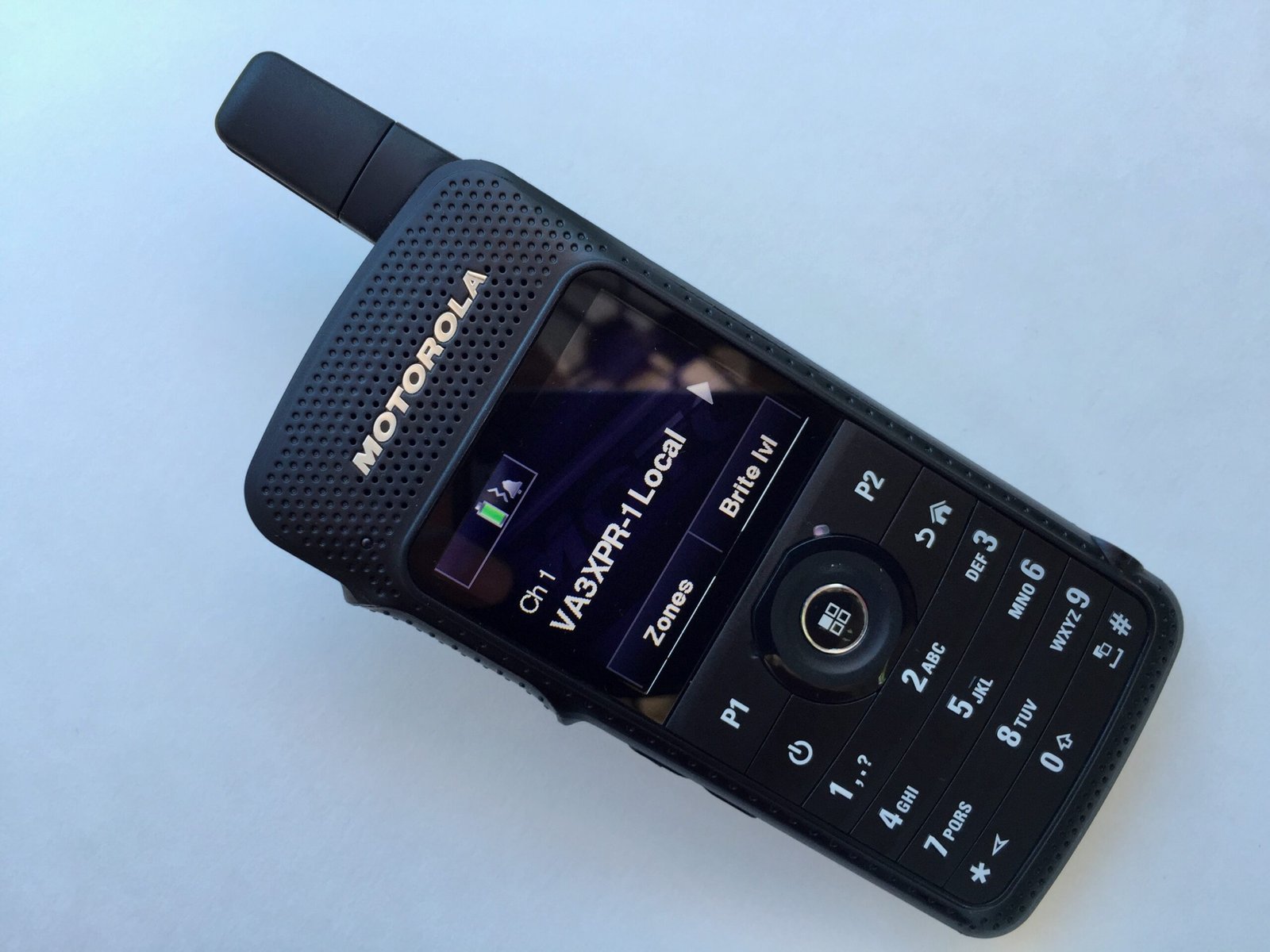

Still one of the most compact professional DMR portables ever made, the Motorola SL7550 blends business-class refinement with ham radio versatility. Its ultra-slim, pocket-friendly design, colour LCD, and built-in Bluetooth make it ideal for operators who value portability and style over high-power output. While newer models like the SL 3000e have taken the stage, the original SL7550 continues to serve hams seeking a discreet and reliable 2 W UHF DMR handheld.
1 Quick Facts About the Motorola MOTOTRBO SL7550
| Band Coverage | UHF 403–470 MHz or 450–512 MHz (single-band) |
|---|---|
| Modes | DMR Tier II (digital only) |
| Output Power | 2 W (fixed, non-adjustable) |
| Display | Colour LCD with day/night modes |
| Audio Output | ≈ 500 mW (average volume) |
| Contacts | Up to 1,000 digital contacts |
| Channels & Zones | 1,000 channels / 250 zones |
| Programming | Motorola CPS 2.0 (USB or Bluetooth) |
| Antenna | Internal non-removable antenna |
| Battery | 3.7 V / 2,300 mAh Li-ion (slim pack) |
| Water/Dust Rating | IP54 / MIL-STD-810 C-G ruggedness |
| Connectivity | Bluetooth 4.0 + micro-USB charging |
| Dimensions (W×H×D) | 55 × 121 × 17 mm (≈ 4.7 oz / 135 g) |
| Typical Price (2025) | $275 – 350 USD used / Discontinued new |
2 Pros and Cons at a Glance
| Pros | Cons |
|---|---|
| Ultra-slim and lightweight design (pocket-friendly) | Low fixed 2 W output power only |
| Bright colour LCD with day/night mode | No analog FM support – DMR only |
| Built-in Bluetooth for wireless audio & programming | Internal antenna limits range and gain |
| High-end build quality with IP54 rating | Audio volume weaker than larger portables |
| Still supported by Motorola CPS 2.0 and RM software in 2025 | Expensive compared to modern dual-band alternatives |
3 2025 Update & Firmware Notes
Status: Although discontinued, the Motorola SL7550 and SL7580 remain fully supported in Motorola’s MOTOTRBO CPS 2.0 software suite (v2.130 and later). Firmware updates up to R02.10.01.0001 are available via Motorola Online.
Compatibility: The SL7550 shares accessories and programming profiles with the newer SL3000e/SL3500e radios. Its older Bluetooth 2.1 module still pairs with most wireless headsets and PTT devices.
Used-Market Tip: When buying used, verify that the radio’s firmware and flashcode support DMR Tier II (Conventional) – some fleet units are locked to Capacity Plus or Connect Plus systems.
4 Who It’s For
- Operators needing a discreet, business-class DMR handheld for office or travel use.
- Urban users within close range of a repeater or hotspot.
- Collectors and Motorola enthusiasts seeking a premium MOTOTRBO experience.
- Hams prioritizing style and portability over transmit power.
5 Introduction
Released in the mid-2010s, the Motorola SL7550 set a new benchmark for slim, professional-grade DMR portables. At only 17 mm thick and just 135 grams, it was the “executive radio” in Motorola’s lineup – equally at home on a business-suit lapel as in a ham’s pocket. Despite being replaced by the SL3000e series, the original SL7550 remains an impressive example of Motorola’s engineering finesse.
6 Design & Build Quality
Motorola’s industrial design shines here: the Motorola SL7550 feels more like a smartphone than a radio. Its smooth contours, glass screen, and top-mounted controls make it intuitive and professional-looking. Despite its elegance, it meets MIL-STD-810 C–G for shock, vibration, and humidity resistance, plus IP54 dust/splash protection.
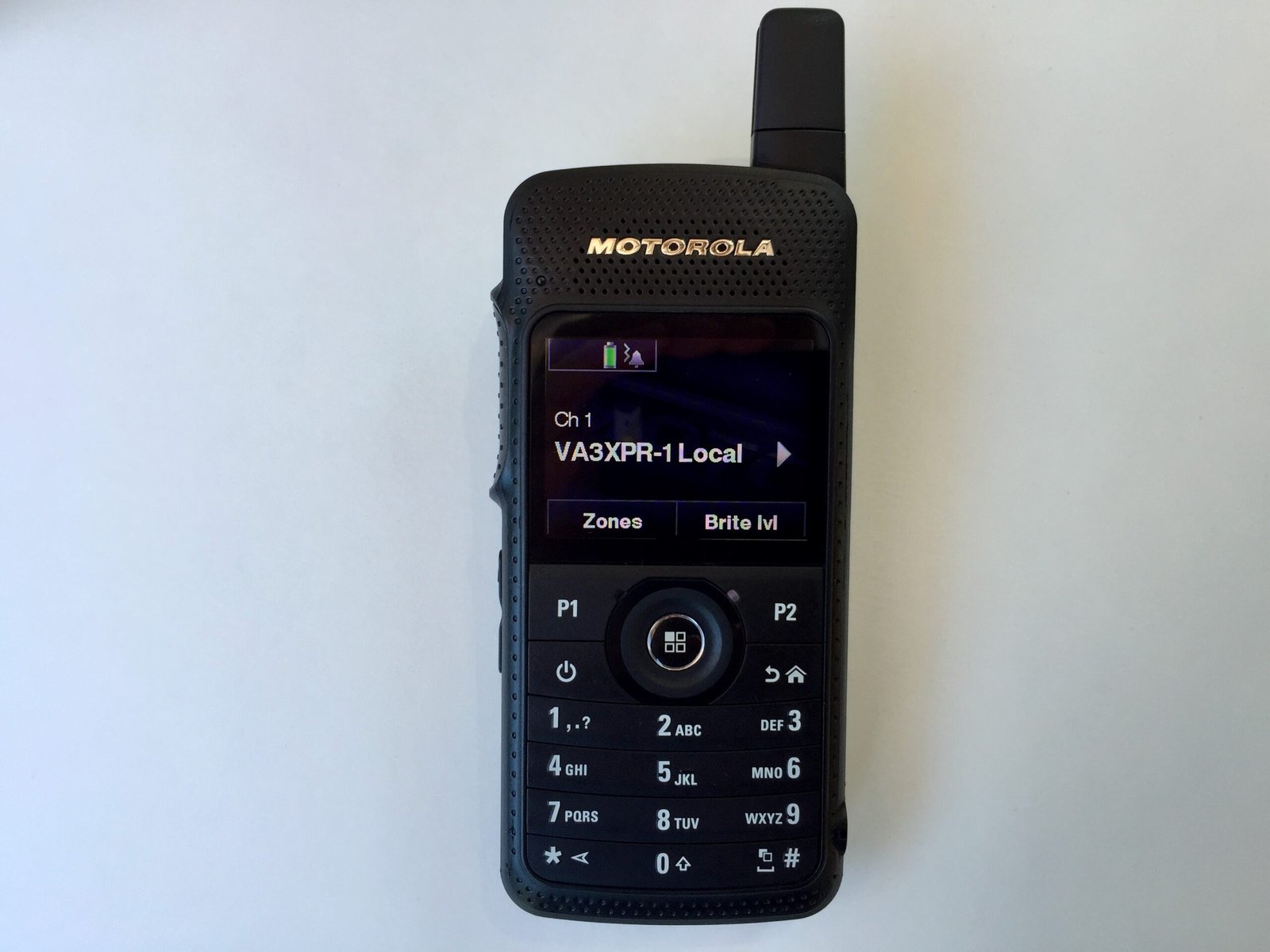
The fixed internal antenna contributes to its sleekness but limits range slightly compared to full-size DMR handhelds. Still, it’s ideal for indoor, vehicle, or hotspot use.
7 Performance (Audio, RF & Display)
Audio Quality: Audio clarity is excellent at moderate volume but can sound harsh when maxed out. Expect roughly half the loudness of a full-size XPR7550e.
RF Performance: The 2 W output and internal antenna make this a short-range performer – ideal for use with a nearby repeater, hotspot, or simplex within a few kilometres.
Display: The colour LCD remains bright and easily readable. The day/night toggle automatically adjusts contrast for indoor or outdoor visibility — a luxury few DMR portables offered at the time.
8 Programming & Software
Programming the Motorola SL7550 is handled through Motorola MOTOTRBO CPS 2.0, using either a standard micro-USB cable or wireless Bluetooth – a feature that was ahead of its time. The codeplug structure mirrors the XPR series, so users familiar with other MOTOTRBO radios will feel right at home.
Note (2025): CPS 2.0 now requires a paid subscription tied to a Motorola Business Online account. The older CPS v16.x series still works for legacy users but is no longer officially distributed.
While the CPS 2.0 software provides an intuitive interface and extensive configuration control, it’s expensive for individual hams – typically costing about US $300 for a three-year subscription. That’s a steep entry point compared with the free programming tools offered by brands like TYT, Anytone, or Hytera.
Because of this, many operators prefer to buy used SL7550 units that already include a working codeplug or rely on a local club member who can assist with programming.
9 Battery, Accessories & Package Contents
The SL7550’s 3.7 V / 2,300 mAh Li-ion battery provides about 8–10 hours of typical DMR operation. Charging is via micro-USB or an optional desktop cradle (PMLN6701A). The radio also supports Bluetooth headsets, wireless PTTs, and Motorola’s discreet audio accessories.
Included in Box (original kit):
- Motorola SL7550 radio (UHF 403–470 MHz or 450–512 MHz)
- 3.7 V / 2,300 mAh Li-ion battery (1,800 mAh on early units)
- Carry holder & belt clip
- Micro-USB charger & cable
- User manual & 2-year warranty
Optional accessories (still available via Motorola Solutions dealers in 2025):
- Desktop charging cradle (PMLN6701A)
- Bluetooth audio kit (NNTN8191)
- High-capacity battery (PMNN4468 – 2,300 mAh)
10 Alternatives to Consider
- Motorola SL3000e: Modern successor with improved audio, better RF range, and USB-C charging.
- Anytone D878UV II Plus: Dual-band DMR & analog radio with GPS and Bluetooth 5.0.
- Hytera PD365: Compact DMR handheld with removable antenna and analog support.
11 Final Verdict
The Motorola MOTOTRBO SL7550 remains a remarkable fusion of style and engineering – even a decade later. While its low power and fixed antenna make it less suitable for field operations, it excels for urban, office, and hotspot use where compactness and discretion matter. If you find one in good condition for under $350 USD, it’s still a capable and conversation-starting piece of Motorola history.
12 Related Reading on EvoHam
- Motorola XPR 7550 Review: A Top DMR Radio for Ham Operators
- Motorola SL300 Review (2025): Pocket-Sized DMR Performance
- DMR for Beginners: How to Get Started in Digital Voice
Some links in this article are affiliate links. If you purchase through them, EvoHam may earn a small commission – at no extra cost to you. Your support helps keep EvoHam creating independent ham radio reviews and guides for the amateur radio community.
The Review
Motorola SL7550
The Motorola SL7550 is an ultra-slim, business-grade UHF DMR handheld with a bright colour LCD and Bluetooth. Great for pocketable, short-range use near a repeater/hotspot, but limited by 2 W fixed power, internal antenna, and DMR-only operation.
PROS
- Ultra-slim & pocketable
- Colour LCD (day/night)
- Bluetooth audio & programming
- Pro-grade build (IP54, MIL-STD)
- Familiar MOTOTRBO UI
CONS
- UHF only; no VHF
- DMR-only (no analog FM)
- Fixed 2 W output
- Internal antenna (no SMA)
- Lower max speaker volume
- Used market: flashcode risk
Review Breakdown
-
Build Quality – Slim IP54 body with solid construction
-
Audio Quality – Clear but lower volume from small speaker
-
Display & Controls – Bright colour LCD; compact keypad
-
Ease of Programming – Intuitive CPS but costly for hams
-
Battery Life – 8–10 hrs typical use; micro-USB charging
-
Features & Connectivity – Bluetooth audio; DMR-only mode
-
Value for Money – Premium feel but high software cost